Bridging the Gap
Between Paper Exams
and Real Code.

Origin & Authenticity
PseudoStudio began with a simple observation: teaching algorithms on paper is fundamentally flawed. Managing an offline tutoring business highlighted how students spend months learning theoretical logic but have no standard way to verify if their code actually works until red pen grading fails them.
We created this platform to bridge the gap between static theoretical textbooks and modern programming principles. By offering a real-time, online pseudocode compiler that mirrors actual exam syllabus logic, students can finally test their hypotheses instantly.

No More Dry Runs
The "Dry Run" Trace Table is the traditional educational bottleneck. When evaluating complex nested loops or 2D array assignments on paper, students are required to track every single variable change manually.
A simple arithmetic mistake on row two cascade-fails the whole evaluation. PseudoStudio is the cure. Hit run, and watch the terminal output your logic instantly, enforcing Computational Thinking far faster than textbook theory.
Detailed Platform Tour
When students and educators ask what PseudoStudio actually *does*, here is the breakdown of the engineering behind our online interpreter.
Serverless Cloud Execution Engine
PseudoStudio is not a simple frontend UI simulation. When you click "Run Code," your logic is sent to a custom-built Python interpreter running serverless on Google Cloud Functions. This provides isolated, secure, and true compilation, delivering immediate terminal feedback that exactly matches the theoretical evaluation expected on paper.
Advanced 'Pro Mode' Linter
Powered by the Monaco Editor (the technology behind VS Code), our editor features a proprietary Linter calibrated specifically for syllabus-aligned pseudocode. The linter dynamically flags missing blocks (e.g., unmatched IF/ENDIF), invalid operators (e.g., using Python's == instead of the syllabus =), and misspelled standard commands, reducing lazy syntax habits.
Cross-Platform Project Sync
Utilizing Firebase's secure cloud database, registered users can manage their algorithmic solutions from any device. Students can start a nested loop assignment in their school computer lab and resume exactly where they left off on their home laptop or tablet.
Real-Time Cambridge Alignment
Unlike general-purpose programming compilers, PseudoStudio's logic is specifically calibrated to ignore commands not found in the theoretical Computer Science syllabi for IGCSE 0478, A-Level 9618, and equivalent O-Level/IB computer science criteria. This keeps students focused on mastering standard computational thinking within their academic boundaries.
Curing "Syntax Soup"
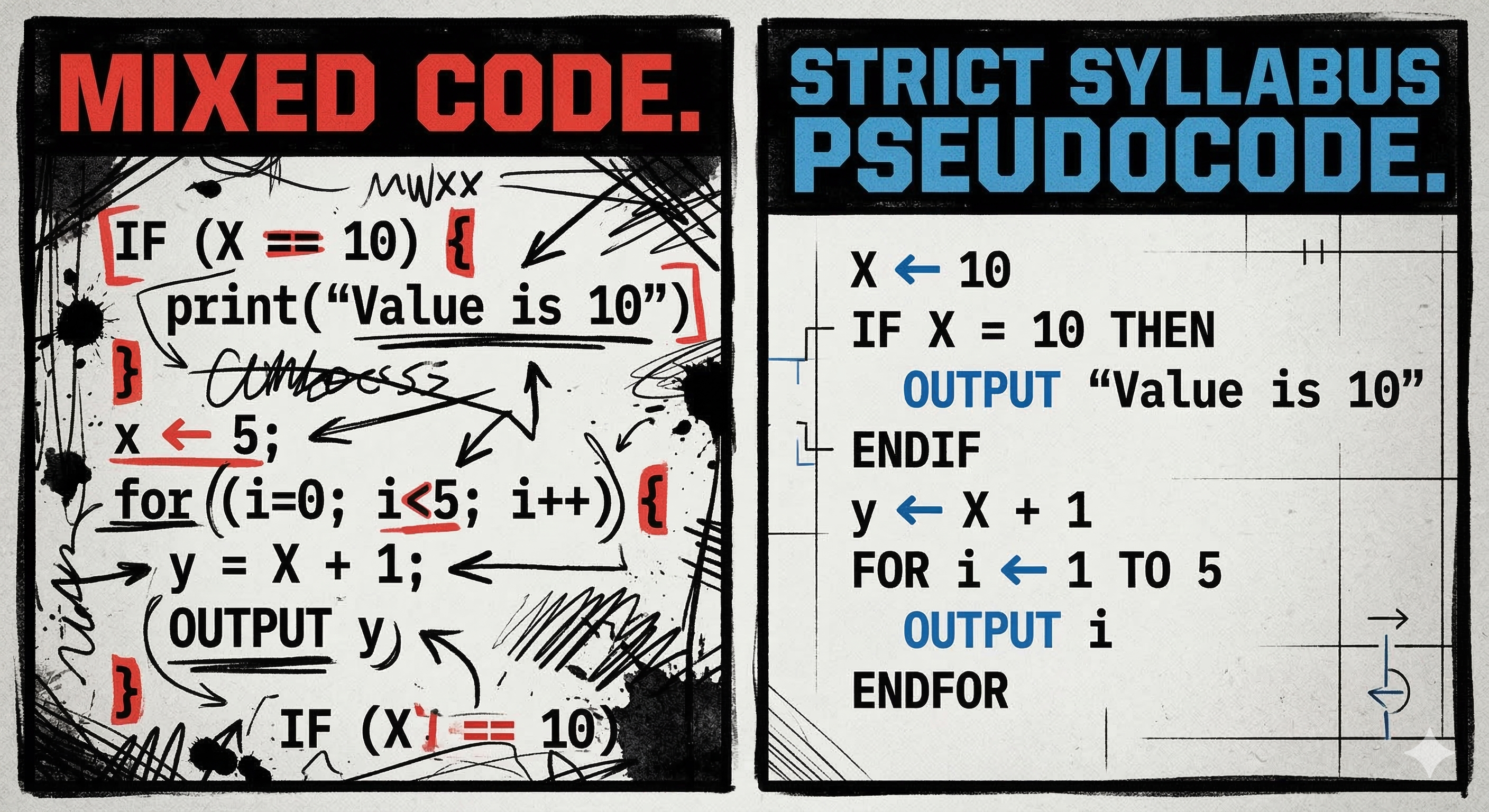
When students bounce between Python for coursework and Pseudocode for paper exams, they inevitably blend them into a messy "syntax soup". Our Pro Mode linter flags these errors dynamically, identifying when a student uses Python syntax in a Pseudocode environment.
By strictly enforcing native syllabus syntax—such as requiring OUTPUT instead of print()—students build accurate muscle memory so they don't lose vital marks on their final papers.
Who We Built This For
We didn't build a generic code runner. PseudoStudio was engineered specifically to solve the distinct challenges faced by these three groups.
IGCSE & O-Level Students (0478 / 2210)
Paper 2 algorithm questions can be intimidating. We provide a safe, interactive sandbox where students can practice loops, arrays, and conditional statements. Being able to see logic fail and correct it in real-time builds the confidence needed to tackle 15-mark algorithm design questions.
A-Level & IB Computer Science Candidates
As the syllabus advances into complex modular programming, testing code mentally becomes highly prone to error. Our interpreter natively supports A-Level 9618 requirements, including parameter passing (BYVAL/BYREF), custom Functions, Procedures, and multi-dimensional array manipulation.
Computer Science Educators
Teachers spend countless hours hand-grading trace tables and trying to decipher student logic on paper. PseudoStudio gives educators a platform where students can self-verify their work, freeing up classroom time to focus on teaching core computational concepts rather than playing syntax-checker.

Meet The Creator
Aneesh
"As an active ICT and Computer Science tutor, I watched my classes struggle daily with the disconnect between writing code on paper and actually seeing it run. The true spark for PseudoStudio came directly from the classroom—when two of my students, Jash and Aarush, mentioned how much a real interpreter would help them learn and test their logic. I built this platform for them, and for every student who wants to stop guessing and start proving their code.
Looking back, I just wish I could have built it sooner for some of my first and best students, Divyanshi and Vanishri, when they were dealing with the exact same trace tables. But even without this tool, they were able to code better than I ever could have expected."
Try The IDE Today